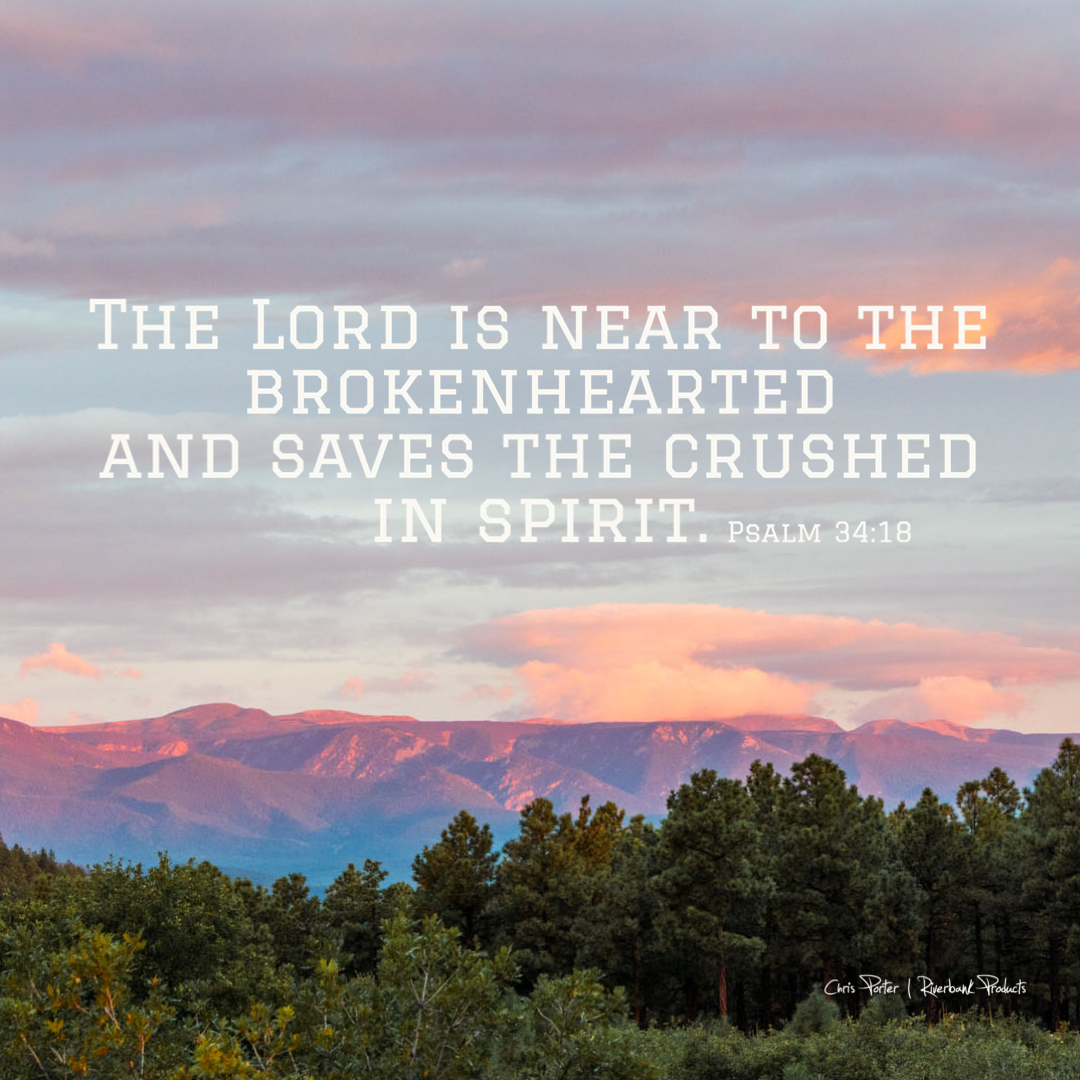
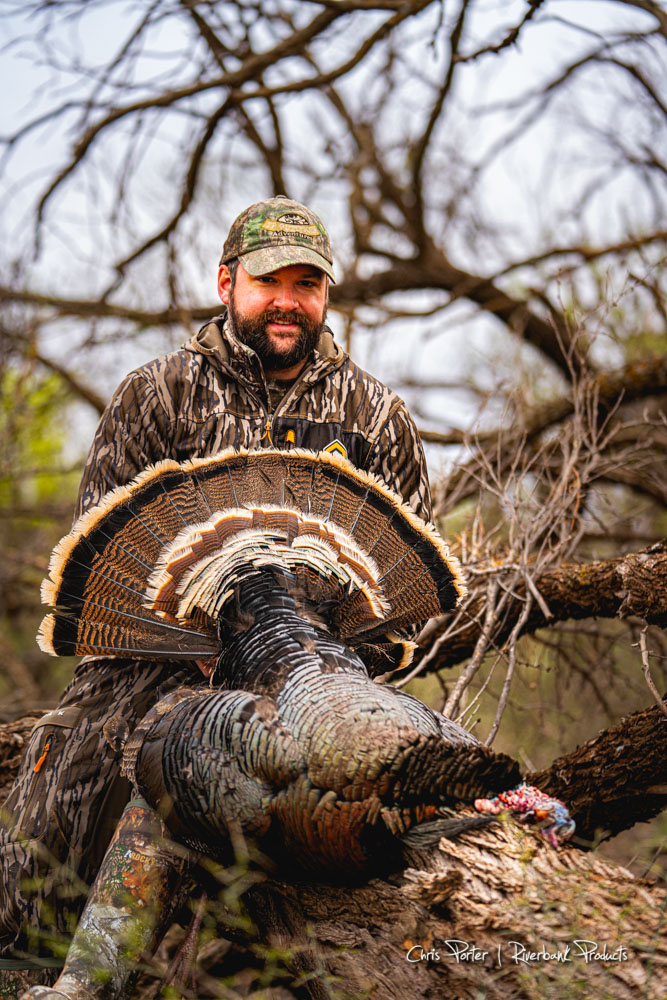
I shot this photo in New Mexico a few years ago. At the time, I was absolutely crushed and battling for my life with some things. He reminded me on top of a mountain while chasing an elk that “The Sovereign Lord is my strength; he makes my feet like the feet of a deer, he enables me to tread on the heights.” Habaakkuk 3:19
God eventually worked most of the issues out even though I wish I had never had to go through it. I still face heartachs and many battles. While I have lots of high points to be thankful for, there are many low points in my personal life. My life is far from perfect but… God is at work and he enables us to rise above when we don’t have the strength to carry on without him. He becomes our strength when we focus on him.
This Fathers day weekend, remember that no matter what you go through our heavenly Father loves us. He loves us even when we can’t see him. Though we can’t be in his presence, he is near. All we have to do is Call out to him. He is Soverign and his will is perfect no matter how hard the struggle may be.
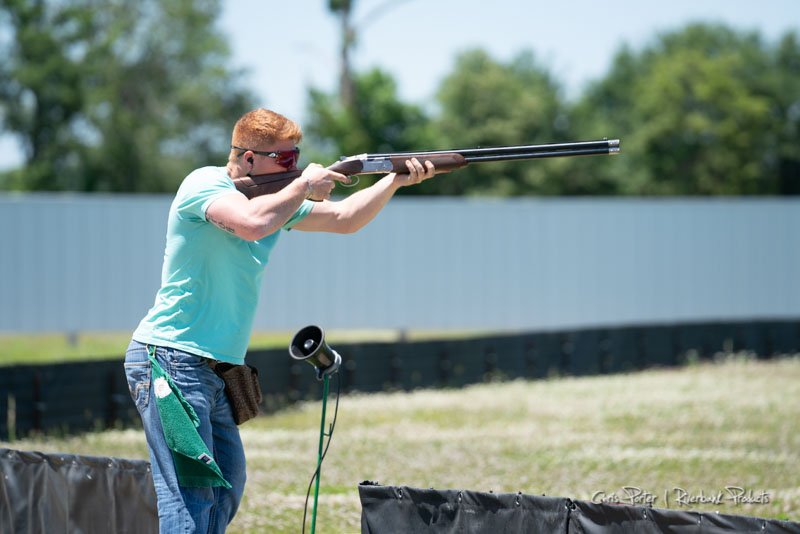
In full disclosure, Cottonland Gun Club has been a client of ours for a few years now. I’ve attended several helice shoots as a photographer and I’ve managed the Cottonland Gun Club website for about a year now. However, last weekend was my first chance to actually shoot a round of helice with a shotgun.
A little about my shooting background
I’ve loved shooting and especially shotgun sports or anything you can hunt with a shotgun since I was a kid. Growing up, duck and dove hunting were my favorite things to do. Sporting clays became a favorite past time during college. I’ve entered a few competitions but never really been into competitive shoots. Just shooting for fun with some close friends and family can be a lot of fun.
In about 2001 or 2002 shooting clays became a weekly event. A couple of good friends in college gathered up almost every weekend to shoot skeet or trap. I even made a brief attempt to start a college trap club at the University of Central Arkansas, but it never really got off the ground good.
These days I find myself filming someone with a shotgun from behind a camera more often than with a shotgun in front of the camera. However, Shooting is still something I really enjoy. So when I found out Glynn Kipper was having a practice shoot, I had to go shoot a round of Helice for myself.
Practice Shoots at Cottonland Gun Club
Practice shoots are much more informal than the large US Helice Association sanctioned shoots the Kipers host each quarter at their range. These shoots are more or less pulled together a week or so ahead of time depending on weather and other schedules and pretty laid back. Perfect for my preferred shooting style.
My First Round
With a good bit of trap shooting in my back ground, I have to say Helice is similar but much more difficult than traditional trap. The main thing is there are 5 different traps that can throw a target instead of one. On top of that, each trap is in constant oscillation so even if the far right trap is released, it may fly all the way to the left or it may go right. You just don’t know and you have to see the bird and resist the urge to move to it until you’ve identified which direction it is going. I feel like I did an ok job of handling these targets but with this on your mind, I found it easy to miss the targets that presented more like a normal trap target. It is very much a mental game.
A factor that compound the target difficulty for the day we shot was the wind. It was very windy and on top of that, the wind was at our back all day. This meant that the targets were moving even faster and more random than normal. As soon as the light plastic propeller shaped targets caught the wind, those suckers were gone.
With helice shooting, the white center target has to be knocked out of the target and fall within a fenced ring in front of the traps. The day we shot, the wind was blowing so hard that we actually suspended this rule because almost none of the white caps were falling inside the ring. Even with a near perfect shot, the wind would carry the white center cap beyond the fence.
I had a great time shooting helice. I may be a little rusty but at the end of the round, I had hit 15 of 30 targets. Mr Kiper said this was pretty decent for my first time shooting. He said a typical first time score is usually in the 8-10 range. There were definitely some targets that I think I should have hit but didn’t so I’ll take it. I believe the high score for that round that day was 25 or 28 targets. Of the matches that I’ve been to, there have been few perfect scores.
Will I shoot again?
I’d love to shoot again. It was challenging and fun. The targets really do fly a lot more like live birds than pretty much anything i’ve ever shot but live birds while hunting. I think that’s really what makes this sport so appealing and why its growing here in the US.
The big question on my mind though is “will I keep shooting Helice?” As I mentioned earlier, i’m not really a competitive shooter. For me personally, the competition aspect kinda takes the fun out of it. That is not to say that you shouldn’t take up the sport. If you like competition and a competition that is a challenge. You’ll love the sport of Helice. For me personally, I’ll defiantly shoot again. The next time I’m free on a practice day, you may see me again with my shotgun and a camera.
In 2020, The Corona Virus, Covid-19, The China Virus, The Rona, what ever you want to call it, it rocked the world. Personally, I’ve been very blessed to have seen very few effects from it. I haven not caught it and no one in my family has had it. I’m a bit of a home body anyway so it really didn’t affect me in the dramatic fashion that it changed other peoples lives. One way it did affect me though is it totally ruined my 2020 turkey season.
I’ve been filming for T.P. Outdoors Adventures for several years now and each year, we usually end up in Texas, chasing Rio Grand Turkeys. They sure are fun to hunt and make quite the movie stars. However, as The Rona lockdowns took effect, Louisiana’s per capita infection rates were very high which prompted Texas to close its borders to Louisiana Residents. Being from Arkansas, It technically didn’t affect me at the time but everyone else in our group was from Louisiana so that really canceled our trip.
I also had a personal hunting trip to Kansas planned with another friend. Right before our trip, Kansas stopped selling out of state hunting licenses so that was out. Although I did get a little Arkansas turkey hunting in, with very few turkeys in arkansas and fewer places to hunt, my opportunities to kill a turkey in my home state were pretty slim. Other than one unsuccessful youth hunt and an unsuccessful hunt with a friend, My 2020 turkey season was nothing to write home about.
This year, our annual turkey trip entourage would consist of Bill Petrus, Brad Bell, Paul Miller, and Mike Mulhern. With the exception of Brad Bell, all are seasoned hunters. As for Brad, this would be his first time turkey hunting and he was in for an experience.
We’d be hunting about half way between Abilene and Sweet Water Texas. As you travel west along I-20 its amazing how the geography and ecology of the surroundings change. From the swamps of Louisiana, to the Pines of East Texas, you then drop off into rocky mesquite county near Dallas ripe with rattle snakes, Jack rabbits and Rio Grand Turkeys.
For all intents and purposes, there are four distinct sub species of wild turkey in the US. The Eastern’s which we have here at home. Rio Grands located in Texas, Oklahoma, and Nebraska. Scattered through other parts of the western US, you’ll find Miriam. And only in Florida can Osceola turkeys be found. A very limited number of Gould turkeys inhabit parts of southern Arizona/New Mexico, but thay are predominantly found in central Mexico so most people at least in my circle don’t really consider those part of the Grand Slam of turkey hunting.
NWTF Turkey Distribution Map
Not to say that Rio Grand turkeys are specifically easy to hunt but they sure make a fun hunt. If I were to relate them to deer hunting, it’s been my experience that hunting Rios is kinda like hunting 2 year old white tails. Not the hardest critter in the woods to hunt. Now Eastern Wild turkeys I’d say are more like hunting mature 4-5 year old white tails. Many hunters can take a 2 or three year old white tail but very few have the ability successfully harvest keen eyed and wood smart mature bucks year after year. Turkeys are the same way. An Eastern wild turkey will make a fool out of you if you aren’t careful but Rio Grand turkeys can make even a novice turkey hunter feel like they are the best turkey caller in the world. They make excellent movie stars though.
First Hunt
As a photographer/videographer, I do 99% of my hunting with a camera. I still love to hunt though but documenting the hunt is my job. Therefore my hunting usually has to wait until others have filled their tags. The first hunt would go to Bill Petrus and Brad Bell.
Bill Petrus and Brad Bell head out on the first morning hunt.
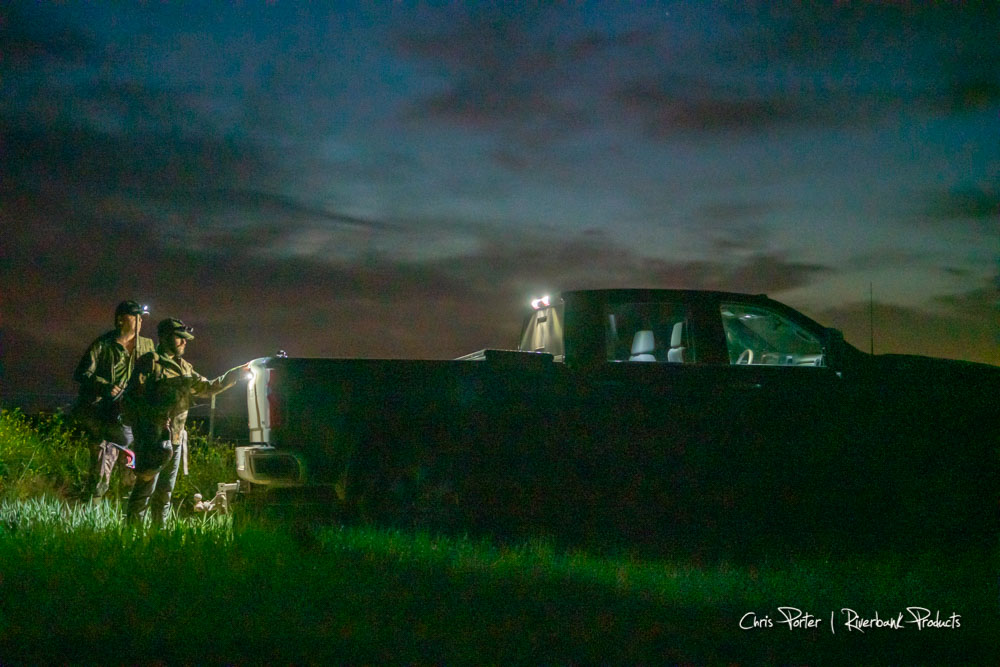
The day we arrived, in west texas, it was nearly 90 degrees. I hoped it wasn’t going to be this warm all week. If so, I had too many warm clothes in my bag. Thankfully, it was cool and crisp as we headed out for our first mornings hunt. A distant coyote howled before sunrise as we got our gear out of the truck. A gobbler fired off an answer. He was roosted about 400 yards away in a fairly narrow wood line bordering a planted winter wheat field.
Our outfitter was right. He had told us that he’d been seeing turkeys along the edge of the field. Sure enough, He was right where we were headed.
We settled into a blind and it wasn’t long before a few hens funneled out onto a dirt road and spilled out into the field. Two gobblers silently followed along. Silent strutters displayed their tail fans to the ladies who seemed more interested in finding a grasshopper or some other morsel to eat.
For me, When wildlife come out like this, two things happen. Your heart jumps a beat when you first see them. Often, my first, thought or words usually come out like, “there they are”. I enjoy the opportunity to view and watch the behavior of such awesome wildlife. We talk about turkey hunting and read about new products and new methods to take the game we chase but to actually get to watch them may only last for a few minutes. Now is the time to soak that in. For me though I’ve got to do what I can to get the photos/video needed and without spooking them.
Secondly, we are here to do some grocery shopping. This is the second thought that comes to mind. Turkeys are very keen eyed. I swear sometimes a blink of an eye can give your position away but now you have to raise a gun to aim without multiple birds seeing you move. It’s a good thing we had a blind because with two gobblers, Bill and Brad hoped to pull off a double.
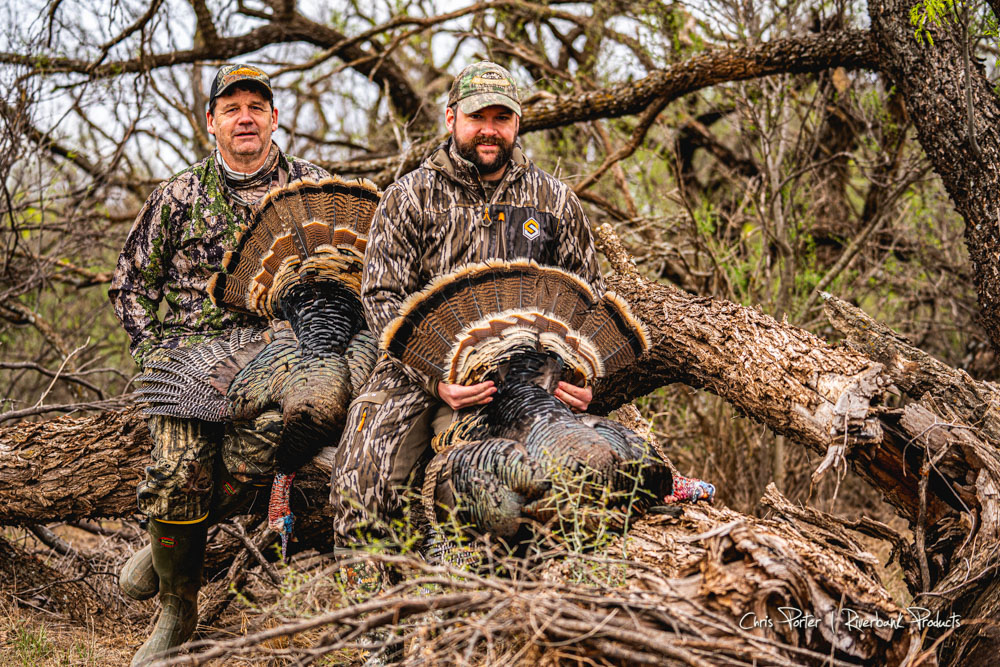
The stars aligned and sure enough, Both birds separated and broke strut giving each a clear shot. After a quick check with each other and a brief 321. Both birds barreled over. Not only did Bill get his bird, Brad Bell had his first turkey.
Bill Petrus and Brad Bell Doubled for Brad’s First TurkeyBrad Bell’s First Wild Turkey
It was my turn
After snapping some photos and dealing with their birds, we grabbed some lunch.
With one pair of tags filled, Bill offered to take over camera duty and it was my turn to try to take a bird.
We headed out to a different property we had permission to hunt and have taken birds from in years past. as we drove past, I looked to the right side of the vehicle and….
“There They ARE!”
Three gobblers surround by cows, gobbled at us in a pasture adjoining the property we were hunting. On top of that, they looked like they were headed to our side of the road.
We drove a couple hundred yards around a corner and quickly gathered our gear to attempt to cut them off. Every move we made here after was calculated.
This is what I love about turkey hunting. Its a cat and mouse game. You use your knowledge of the area and turkey behavior patterns to make an educated guess at what they are going to do and how they are going to react to plan your movements and actions. This Is Turkey Hunting.
We kept mesquite brush between us and where we assumed the turkeys would be traveling as we walked at a brisk pace into location. We found a good hiding spot under some larger mesquite trees and set up to do some calling. Instantly, the three turkeys gobbled. They were on our side of the road for sure but they had already gotten past us and were heading away.
We made a move to narrow the distance and set up again. Not wanting to seem to terribly interested I made a few light clucks and purrs on my Slate Call. They responded with a gobble each time. However, they weren’t coming. Purrs and clucks were getting a response but no real movement in our direction from the birds.
They were on a slight hill above us. I’ve always been taught that you want the high ground. Even though it wasn’t much of a hill, they had the higher ground and moving on them again was out of the question.
After a few minutes, I could see the three gobblers moving from our right to left a couple hundred yards out. they were responding to a call with gobbles but not coming closer. It was time to change tactics.
I began to make a series of excited yelps, clucks and some excited purrs. This stopped them in their tracks as they were looking intent in our direction now. We had two decoys out and I’m sure they could see those now. This also gave them a good view of Bill Petrus holding the fan of his turkey he’d taken earlier that morning.
Now for the record; fanning turkeys can be extremely dangerous, but It works. Each year, you hear horror stories of turkey hunters accidentally getting shot so I don’t recommend anyone fanning turkeys like this on public land where another hunter could mistake you for a turkey. But in this instance, we were the only people with permission to hunt this property and we were all but certain that no other hunters were around.
Between the excited calling, and the turkey fan, all three turkeys began to close the distance. Bit red white and blue heads bobbed through the mesquite trees as they came closer. You could hear one of them drumming as they strutted in.
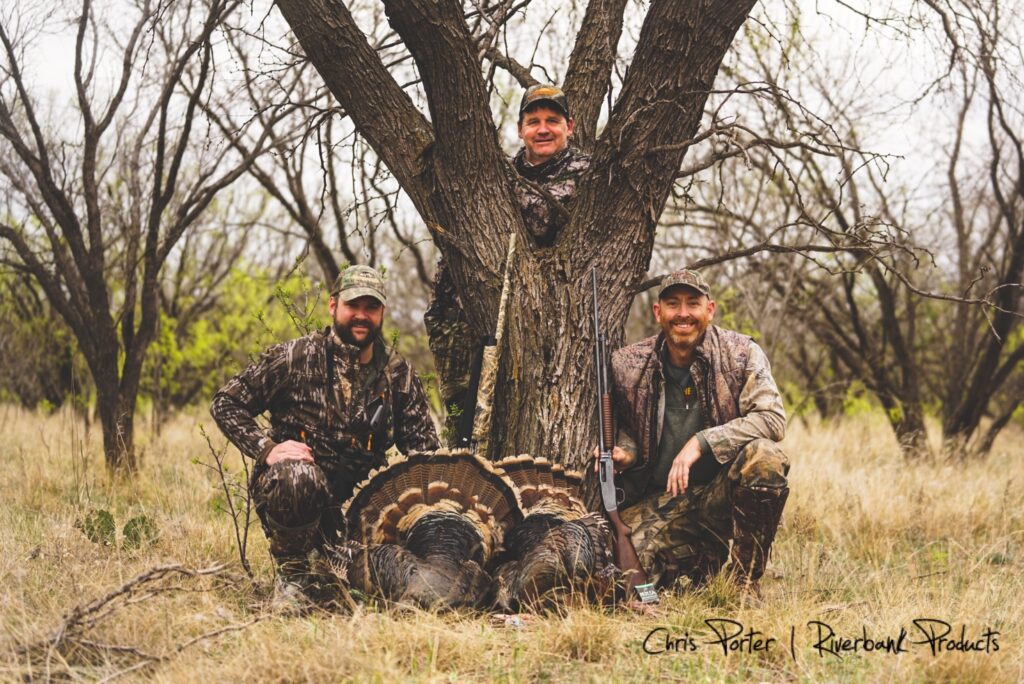
They were well within range of a 12 ga by this point. However, I was hunting with my Great Grand fathers Winchester model 42 shotgun made in 1943. Thats before World War II if anyone is keeping a record. This gun was passed down from my great grand father Bruce Lester Porter to my dad when he was a little boy. The story my dad told me was that he was squirrel hunting with his grand father and only had a single shot 22. As squirrels began to run through the trees, his 22 just wasn’t cutting the mustard so he gave this 410 shotgun to him as a little boy. He killed many squirrels with it as a kid and then when I came along as his first son, I got to take the gun on my first dove hunt and first squirrel hunt with my grand father.
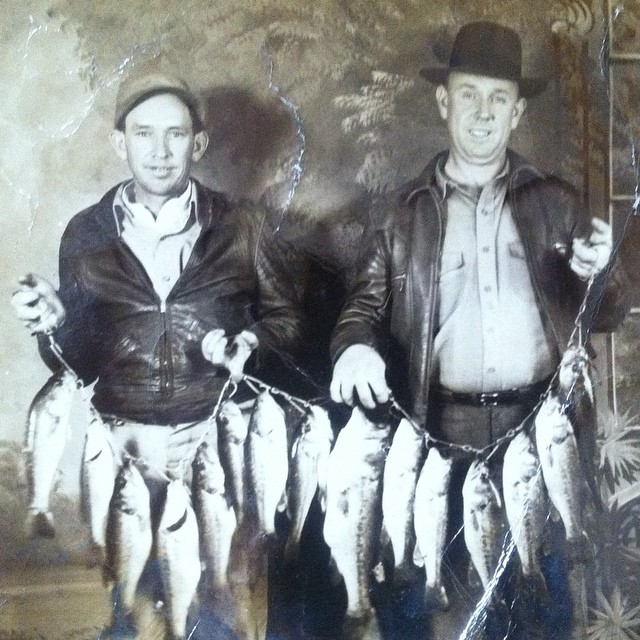
Bruce Porter (right) was an avid outdoorsman. Here he helps hold a stringer of bass
I was shooting Apex Ammunitions TSS 410 Turkey Ninja loads. Based on my patterning, I really needed the turkey to be within 30 yards. A modern 410 with modern choke tubes is deadly at 40 yards and maybe even a little further, but I was comfortable within 30 yards. I also wanted Brad to get the best show from these three gobblers and we were filming for a TV show so we also wanted to get as much video as possible so I tried to get them as close as possible.
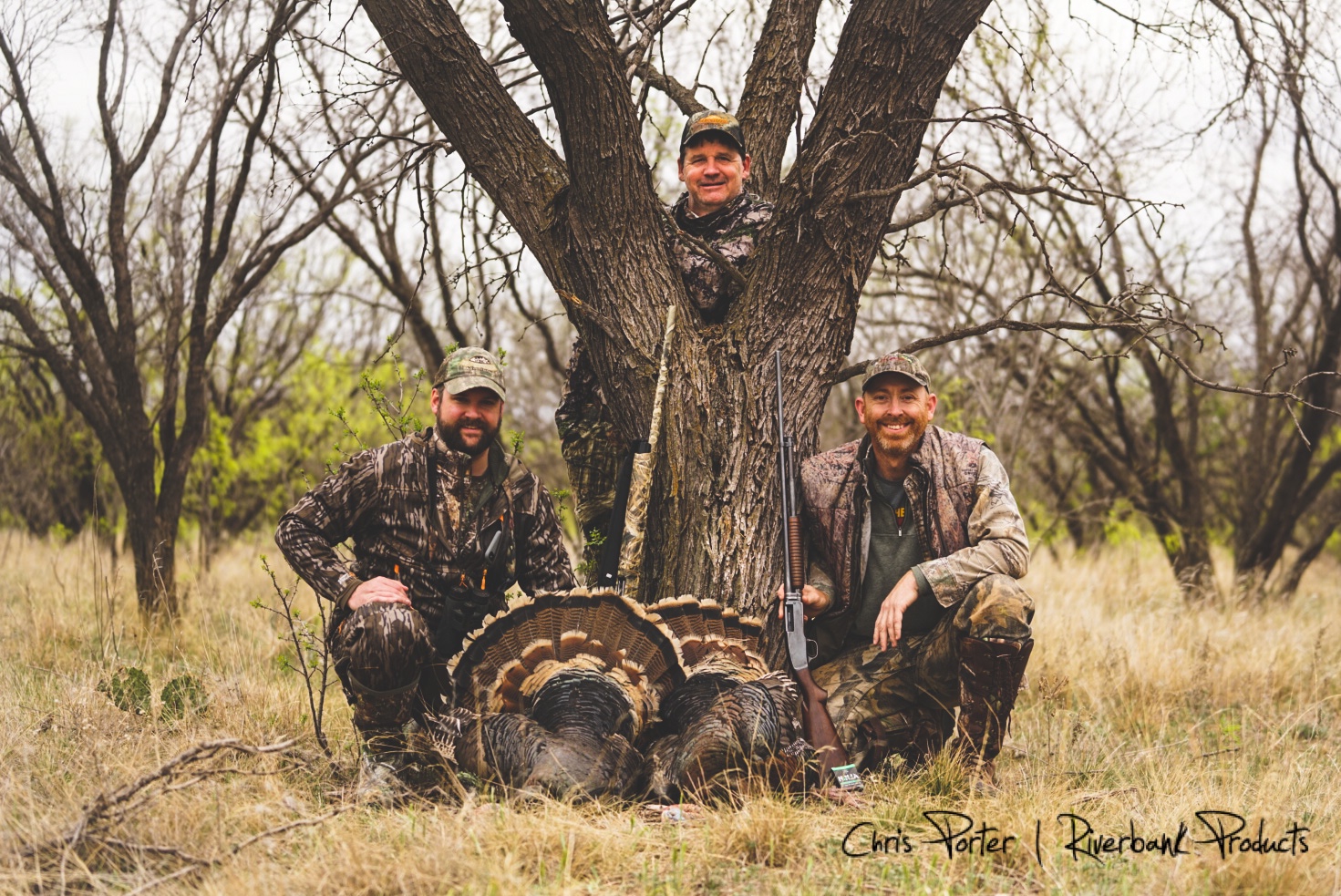
The back two birds were beginning to catch on to the game though. I watched as the back birds head went grey then the middle bird paused and started to turn around but the lead bird was still hot to trot so both birds tagged along cautiously. Brad was sitting to my right and I knew the gig was almost up. The lead bid broke his strut and raised his head. I don’t know if he’d seen movement or heard brad and I but This was it. I called the shot and Brad took his bird but by this time, All three birds had turned and started to run. Brads bird fell but mine was shot on the run and I had to take a body shot. We both took off after him and dispatched the bird.
What a thrill
To be a able to harvest a turkey is exciting stuff. To have two good hunts in one day is awesome. To have not one but three birds play the game is such an experience. To share that experience with good friends amplifies the whole thing to another level. Then to be able to do it with my great grandfather’s shotgun and fulfill a goal that was two years in the making was such and awesome thing. I love it when a plan comes together.
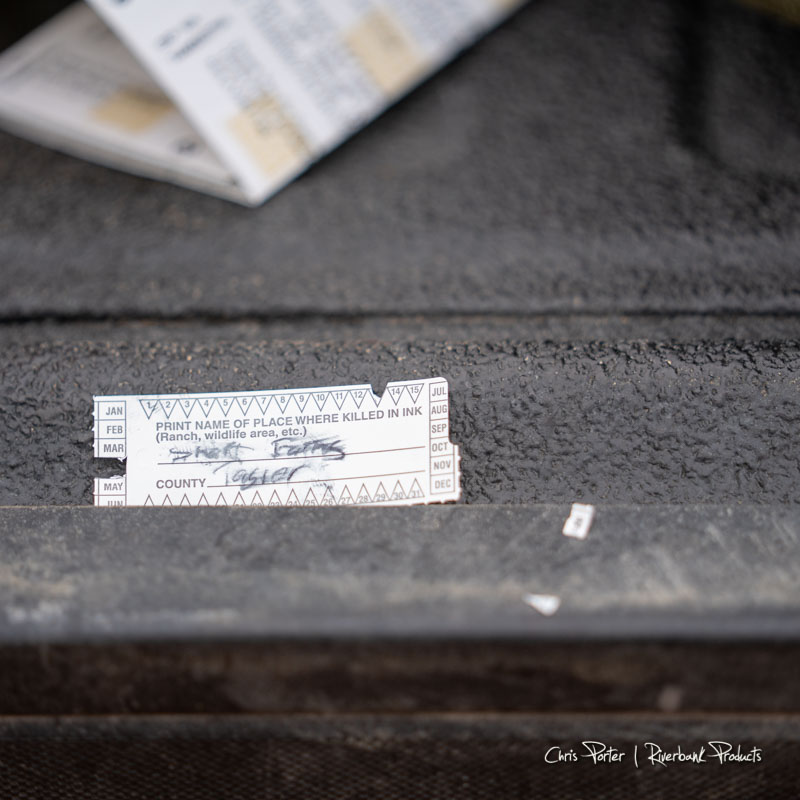
Punched my Texas 2021 Turkey Tag
God has been so good to me. I’ve been blessed with great friends, and an amazing job to get to film some of the things I’ve done and witness his Majesty on display in the outdoors. I truly hope each of you can experience things like this hunt and not just share it with others but invite someone else to share it with.
Like I mentioned, this was Brad Bell’s first turkey hunt. He didn’t really hunt before marriying Bill’s Daughter Emalee. I got as much thrill out of helping teach Brad how to hunt as anything and share some laughs together. I don’t claim to be the worlds greatest turkey hunter but as the birds were coming in, I was able to whisper to brad the whole time, what I was seeing and what i was doing. Just like with my great grand dad’s shotgun that was passed down from him to my dad and then to me, teaching others and passing on knowledge is what makes a hunt. If we all just hunted by ourselves and didn’t share the hunt or share a meal together from the game we harvested, would hunting traditions continue? Would we even still have wild turkey populations in the US without hunters?
Whether its turkey hunting or any other sport, I hope this story of my hunt in texas with some friends and my great grandfather’s shotgun will inspire you to get out and experience God’s goodness and his blessings in the outdoors with your own friends and family and pass it on to the next generation.
If you saw my previous post last year on “Can you turkey hunt with a 410?” your gonna want to see the update from this year as I answered the question.
In short, YES. Yes you can turkey hunt with a 410.
…if you have faith as small as a mustard seed, you can say to this mountain, ‘Move from here to there,’ and it will moved …– Matthew 17:20
Last year I prepared my fall garden; tilling in the remaining summer tomato vines and the last of my green beans. I planned out my rows and what to plant. I dug out some mustard seed that had been collected from the previous years garden.
Mustard greens are similar to turnip greens or collard greens but not nearly as cold tolerant. As collards experience their first frost, the flavors get better and sweeter. Mustards are not the like that. The frost usually kills them or at least knocks them back considerably to the point where you can’t really harvest them.
It was early fall. actually more like late summer and the first frost was still a good month or two away so we had plenty of time to get mustard in the ground and mature to harvest so I put in a row.
South Arkansas is not known for cold weather. This year our first frost would come later than normal. Our first frost would not come until the last of November, first of December. This deep freeze really stunted our mustard greens.
By this time we’d already had several batches of mustard‘s and our collards and turnip greens were already coming along just as well. Not having anything else left to plant. I just left them be without tilling them under.
Winter had set in. Carrots, collards turnip greens, and a little lettuce is about all that remained in the garden throughout the winter and they all did fairly well. not the mustard‘s but some how they managed to stay alive. Well some of them anyway.
Winter made its slow progression as January turned into February. Hoping to make some green manure, the mustard‘s eventually got tilled into the ground. I did however leave one small patch that I plan to leave to go to seed to produce seed for the following year‘s garden. A few random plants had already been pulled up and cast off to the side which didn’t get tilled under but we expected they would soon die since their roots were no longer in the ground. these plants had actually already begun to bolt and were producing flowers.
Right around Valentine’s Day 2021, a strong winter storm, the strongest in my 42 years hit. Many people I talked to in their 80s had also never seen a winter storm hit south Arkansas with over 10 inches of snow and low single digit temperatures and for an extended period of time. My garden was covered a deep blanket of snow for over a week solid.
As the snow finally began to melt away I walked through my garden I noticed the mustard greens that had already been pulled up were still blooming.
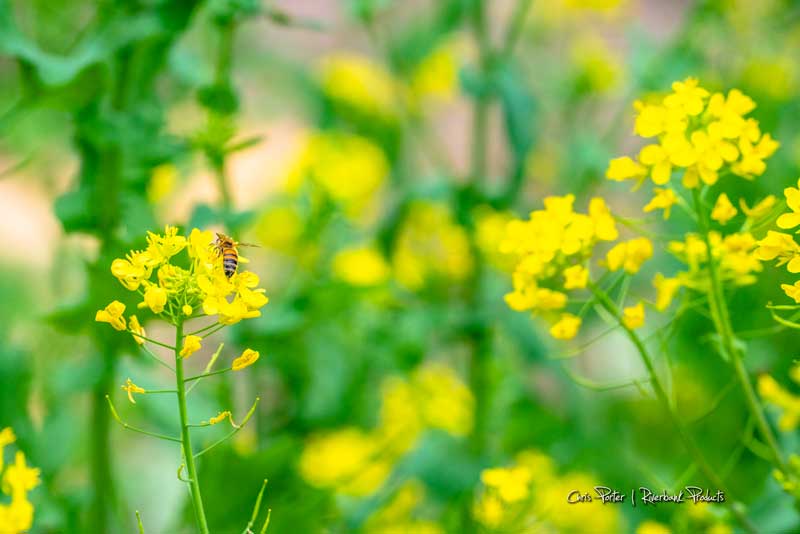
The plants had been pulled up by their roots. they had been tilled under. They had been stomped on. they had been covered in deep snow and frigid temperatures for an extended period of time separated from the other planets. Still, tiny yellow flowers appeared through the melting snow.
So, as soon as the ground dried out. I tilled them under again!
It’s now April. Most of my summer garden has been planted. One or two rows remain barren. One of those rows was my mustard row.
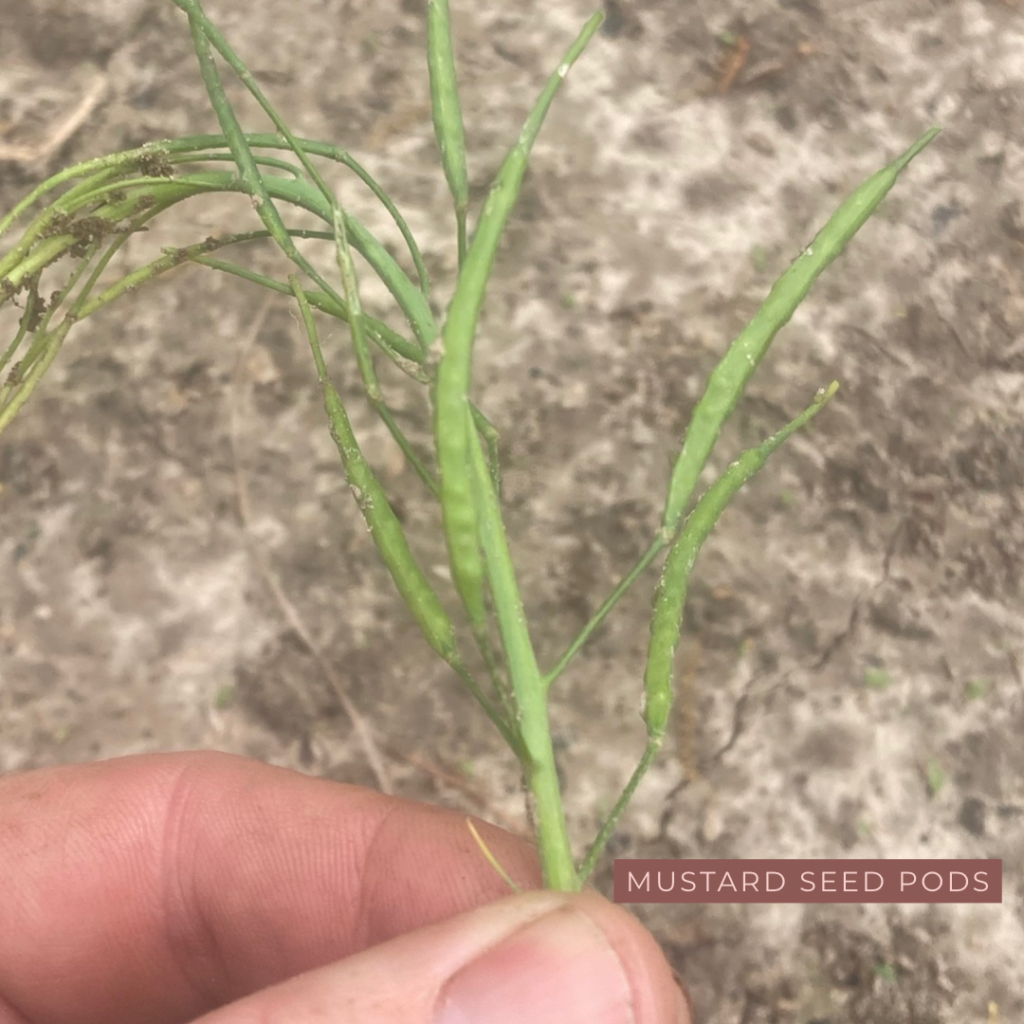
As I looked at the row today, something caught my eye sticking up out of the dirt. I’d planted okra but it is not okra sporting. It was mustard seed plods.
After all the plants had been through, they still managed to bloom, and produce fruit.
Have you ever been left for dead? Pulled out of your preferred situation. No friends. No honey bees fawning over you while you watch others bask in the sun. Alone. Stomped on. Beaten down.
Gods word says we are to have the faith of a tiny, insignificant mustard seed. God my allow you to be beaten down, trampled over, and discarded by the world. We still have to stay focused on Christ.
The saying goes, bloom where you are planted. Never give up. Stay faithful to God for he has not forgotten you. He cares for you and he has given you a job to do. Get busy doing it.